
What Can a CNC Plasma Cutter Cut? A Complete Guide to Plasma Cutting Metal

If you've ever watched a CNC plasma cutter slice through a sheet of steel, you may have wondered just how much it can actually cut.
Can a plasma cutter cut stainless steel? What about aluminum? Can it cut thick plate? Can a CNC plasma table cut small parts, intricate designs, brackets, signs, or custom artwork?
The short answer is:
A CNC plasma cutter can cut a surprisingly wide variety of electrically conductive metals and can turn digital designs into highly repeatable metal parts, signs, artwork, and fabrication components.
At Sparked Metal Works, CNC plasma cutting is one of the ways we turn digital designs and customer ideas into real metal products.
But what exactly can a CNC plasma cutter cut?
Let's take a closer look.
What Is a CNC Plasma Cutter?
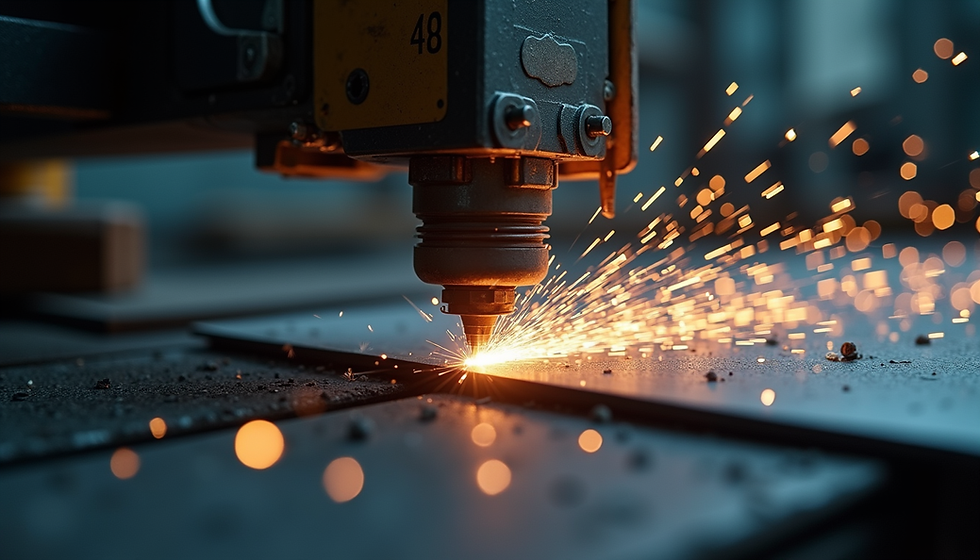
A CNC plasma cutter combines a plasma cutting torch with a computer-controlled cutting table.
CNC stands for Computer Numerical Control. Instead of manually guiding a plasma torch around a piece of metal, a computer controls the torch movement according to a digital design file.
This allows a CNC plasma cutting machine to produce repeatable shapes, holes, lettering, artwork, brackets, parts, signs, and other custom metal components.
The basic process looks something like this:
Digital design → CNC software → plasma torch → precision metal cut
The result is a fast and versatile method of CNC metal cutting and fabrication.
Plasma cutting works by creating an electrically conductive plasma arc that melts the metal while high-velocity gas blows the molten material away from the cut. Because the workpiece must provide an electrical path, conventional plasma cutting is intended for electrically conductive materials.
What Materials Can a CNC Plasma Cutter Cut?
The most common materials cut with CNC plasma are:
Mild steel
Carbon steel
Stainless steel
Aluminum
Depending on the plasma cutting system and application, other electrically conductive metals can also be cut, including copper, brass, galvanized steel, cast iron, and certain specialized alloys.
Let's look at the most common materials in more detail.
1. Mild Steel and Carbon Steel
Mild steel is one of the most common materials cut on a CNC plasma table.
It's relatively affordable, readily available, weldable, and well suited to plasma cutting.
For a metal fabrication shop, mild steel can be used for an enormous variety of projects.
Examples include:
Custom metal signs
Address signs
Ranch signs
Business signs
Metal wall art
Fire pits
Fire rings
Brackets
Plates
Mounting tabs
Machinery components
Decorative panels
Automotive parts
Garden art
Custom fabrication components
This is one reason CNC plasma cutting has become such a useful tool for both professional metal fabricators and smaller fabrication shops.
Mild steel is also commonly referred to as carbon steel, although there are many different grades and specifications of carbon steel.
2. Stainless Steel
Yes, a CNC plasma cutter can cut stainless steel.
Stainless steel is electrically conductive, making it compatible with plasma cutting.
However, stainless steel behaves differently from mild steel during cutting. The appropriate amperage, travel speed, gas, consumables, and machine setup all influence the final cut quality.
Stainless steel is particularly useful when corrosion resistance and appearance are important.
Potential CNC plasma applications include:
Custom signs
Decorative panels
Restaurant components
Equipment parts
Brackets
Machinery components
Architectural metalwork
Custom artwork
For applications where the appearance of the cut edge matters, the cutting process and post-cut finishing should be considered when choosing between plasma cutting, laser cutting, waterjet cutting, and other processes.
3. Aluminum
Aluminum can also be cut with a CNC plasma cutter.
This is one of the advantages of plasma cutting over some other traditional metal-cutting processes.
Aluminum conducts electricity, but its thermal properties make it behave differently from mild steel during plasma cutting. Machine settings, gas selection, material thickness, and table configuration can all affect the result.
CNC plasma-cut aluminum can be useful for:
Lightweight brackets
Panels
Signs
Decorative pieces
Equipment components
Custom fabrication
Prototypes
If you're considering aluminum for a project, it's important to determine whether plasma cutting is the best process for the required thickness, edge quality, and dimensional tolerance.
4. Galvanized Steel
Galvanized steel can be plasma cut, because the underlying steel is electrically conductive.
However, galvanized material requires additional consideration because of its zinc coating.
Cutting galvanized metal can produce hazardous fumes, so appropriate ventilation, fume extraction, respiratory protection, and other safety controls are important.
For fabrication shops, the material coating should always be considered when selecting the cutting process and safety procedures.
5. Copper and Brass
Copper and brass are also electrically conductive, so plasma cutting is possible.
However, these materials can be more challenging than mild steel because of their thermal and material properties.
Copper and brass can require different cutting parameters and may produce different edge characteristics compared with steel.
For specialized projects, the material, thickness, machine capability, and required finish should all be evaluated before choosing plasma cutting.
How Thick Can a CNC Plasma Cutter Cut?
This is one of the most common questions people ask:
"How thick can a plasma cutter cut?"
There isn't one universal answer.
The maximum thickness depends on the plasma power supply, amperage, torch, consumables, material type, gas, machine setup, and whether you're looking for a production-quality cut or simply a severance cut.
For example, a small 30- or 45-amp plasma cutter obviously won't have the same cutting capability as a large industrial plasma system.
That's why you shouldn't choose a plasma cutter based solely on its advertised maximum thickness.
Clean Cut vs. Severance Cut
This distinction is important.
A manufacturer may advertise a machine as being capable of cutting a certain maximum thickness.
That doesn't necessarily mean the machine will produce a clean, production-quality edge at that thickness.
A clean-cut rating generally refers to a thickness the machine can cut with a useful level of speed and edge quality.
A severance rating is closer to the maximum thickness the machine can separate under suitable conditions.
If you're ordering precision metal parts, the clean-cut capability is generally more important than the absolute maximum thickness.
What Can a CNC Plasma Cutter Make?
This is where CNC plasma cutting gets really interesting.
A CNC plasma table isn't limited to simple straight cuts.
With the right digital design, a CNC plasma cutter can produce intricate shapes, curves, lettering, holes, silhouettes, decorative patterns, and complex profiles.
That makes CNC plasma cutting useful for both functional metal fabrication and artistic metalwork.
Custom Metal Signs
Custom signs are one of the most recognizable CNC plasma-cut products.
A digital design can be converted into a steel sign featuring:
Names
Logos
Addresses
Ranch names
Business names
Wildlife
Mountains
Trees
Vehicles
Custom artwork
This is particularly useful for personalized outdoor signs, shop signs, garage signs, ranch signs, and business signage.
CNC Plasma Cut Metal Art
CNC plasma cutting is also extremely popular for metal art and decorative metalwork.
Intricate digital artwork can be converted into steel or other conductive metal.
Examples include:
Wildlife silhouettes
Mountain scenes
Western artwork
Automotive designs
Geometric patterns
Garden art
Wall décor
Personalized artwork
Cabin décor
Hunting and fishing designs
Instead of buying a mass-produced decoration, CNC fabrication makes it possible to create something specifically for a particular person or property.
CNC Plasma Cut Parts
Not everything coming off a plasma table is decorative.
CNC plasma cutting is also extremely useful for producing functional parts.
A CNC plasma cutter can be used to cut:
Brackets
Mounting plates
Gussets
Tabs
Flanges
Base plates
Machinery components
Equipment parts
Templates
Prototypes
Replacement components
This makes CNC plasma cutting useful for welders, fabricators, farmers, mechanics, machinists, builders, contractors, and DIY metalworkers.
CNC Plasma Cutting for DIY Projects
One of the biggest advantages of CNC plasma cutting is that you don't necessarily have to be a large industrial manufacturer to use it.
A CNC plasma table can be useful for:
DIY metal projects
Garage projects
Farm repairs
Automotive fabrication
Custom signs
Home décor
Metal art
Fire pits
Fabrication prototypes
One-off parts
The ability to create a digital drawing and repeatedly cut that design makes CNC plasma particularly useful for people who need multiple identical pieces.
What Can't a Plasma Cutter Cut?
There's one simple rule to remember:
A conventional plasma cutter requires an electrically conductive workpiece.
That means a plasma cutter is designed for metals rather than ordinary nonconductive materials.
A conventional plasma cutter cannot be used like a CNC router to cut materials such as:
Wood
Plastic
Glass
Stone
Ceramic
Most nonconductive composites
Plasma cutting depends on establishing an electrical arc through the workpiece, so nonconductive materials don't provide the required electrical path.
If you're trying to cut wood, acrylic, plastic, stone, or another nonmetal material, a different CNC process may be more appropriate.
CNC Plasma Cutting vs. Other Metal Cutting Methods
There isn't one cutting process that's perfect for every project.
Different machines have different strengths.
CNC Plasma Cutting
Plasma is particularly useful for:
Steel
Stainless steel
Aluminum
Medium-to-thick sheet and plate
Custom parts
Signs
Metal art
Fabrication
Prototypes
Production runs
CNC Laser Cutting
Laser cutting can provide excellent precision and is particularly useful for thinner materials and applications requiring very fine detail.
Waterjet Cutting
Waterjet cutting can handle a wide variety of materials and can provide excellent cut quality without the same thermal effects associated with plasma.
Oxy-Fuel Cutting
Oxy-fuel is commonly used for heavier ferrous materials and applications where extremely thick steel needs to be cut.
The right process depends on the material, thickness, tolerance, quantity, budget, and desired edge quality.
Why Use a CNC Plasma Cutter Instead of a Handheld Plasma Cutter?
A handheld plasma cutter is extremely useful for repair work, fabrication, demolition, and freehand cutting.
But a CNC plasma table adds computer-controlled movement.
That provides several advantages.
Repeatability
If you need ten identical brackets, CNC can cut the same design repeatedly.
Complex Designs
Digital artwork can be converted into detailed metal shapes that would be difficult to reproduce by hand.
Consistency
The computer controls the torch movement instead of relying entirely on an operator's hand.
Efficient Material Use
Digital nesting can allow multiple parts to be arranged efficiently on a sheet of material, helping reduce waste.
Customization
A digital design can be modified before cutting, making CNC plasma particularly useful for custom projects.
What Can You Have CNC Plasma Cut?
If you're wondering whether your project can be CNC plasma cut, start by asking three questions:
1. Is the material electrically conductive?
If it's steel, stainless steel, aluminum, or another conductive metal, plasma may be an option.
2. Is the material within the machine's cutting capability?
The machine's power supply, torch, consumables, and material thickness all matter.
3. What kind of finished edge do you need?
Plasma can produce excellent results, but the required tolerance and edge finish may determine whether plasma, laser, waterjet, machining, or another process is the better choice.
What Can Sparked Metal Works CNC Plasma Cut?
At Sparked Metal Works, our CNC plasma cutting service is designed for custom metalwork, signs, artwork, parts, prototypes, and fabrication projects.
Our CNC plasma system can cut material up to 48" × 96", with cutting capability up to 5/8-inch material, depending on the material and application.
That opens the door to a wide range of projects.
We can help with projects such as:
Custom metal signs
Business signs
Ranch signs
Address signs
Metal wall art
Decorative panels
Fire pit designs
Fire rings
Brackets
Mounting plates
Custom metal parts
Prototypes
Replacement components
Garden art
Personalized metalwork
Small production runs
One-of-a-kind fabrication projects
If you already have a DXF, SVG, CAD drawing, sketch, logo, photograph, or simply an idea, we can determine whether CNC plasma cutting is a good fit for your project.
Don't Have a Digital Design?
That's not necessarily a problem.
Many customers know what they want without having a CAD file ready to go.
You might have:
A hand-drawn sketch
A photograph
A company logo
An existing sign
A picture you found online
A rough idea
A design you want modified
The first step is simply figuring out what you want the finished piece to look like.
From there, the design can be prepared for CNC cutting.
For customers who already have their own CNC plasma table or laser cutter, Sparked Digital Designs also offers downloadable DXF files that can be used for DIY metal projects and fabrication.
CNC Plasma Cutting Turns Digital Designs Into Real Metal
That's really what makes CNC plasma cutting so useful.
A design that exists only on a computer screen can become:
A sign.
A bracket.
A fire pit.
A piece of artwork.
A replacement part.
A business logo.
A custom fabrication component.
Or something nobody has ever made before.
The possibilities are limited much more by the design and the application than by the basic concept of CNC plasma cutting.
Frequently Asked Questions About CNC Plasma Cutting
What metals can a CNC plasma cutter cut?
A CNC plasma cutter can cut electrically conductive metals. Common materials include mild steel, carbon steel, stainless steel, and aluminum. Depending on the equipment and application, copper, brass, galvanized steel, cast iron, and other conductive alloys may also be possible.
Can a plasma cutter cut stainless steel?
Yes. Stainless steel is electrically conductive and can be cut with plasma. Proper machine settings, consumables, gas selection, and cutting parameters are important for achieving the desired result.
Can a plasma cutter cut aluminum?
Yes. Aluminum can be CNC plasma cut, although its thermal properties require appropriate settings and machine configuration.
How thick can a CNC plasma cutter cut?
The answer depends on the plasma power supply, material, torch, consumables, and desired cut quality. Maximum severance thickness is not necessarily the same as a production-quality clean-cut thickness.
Can a CNC plasma cutter cut wood?
No. Conventional plasma cutting requires an electrically conductive workpiece. Wood, plastic, glass, stone, and other nonconductive materials are not suitable for conventional plasma cutting.
Can CNC plasma cut small parts?
Yes. CNC plasma cutting can produce relatively small and detailed parts, although the minimum practical feature size depends on material thickness, torch characteristics, kerf width, machine setup, and the design itself.
Can a CNC plasma cutter cut custom signs?
Absolutely. Custom metal signs are one of the most popular applications for CNC plasma cutting.
Can I provide my own design?
Yes. A properly prepared DXF or other compatible vector/CAD file can be used for CNC cutting. If you don't have a finished file, a sketch, image, logo, or design concept can be a starting point for determining whether the project can be converted into a cut-ready design.
Ready to Have Something Cut?
Whether you need custom CNC plasma cutting, metal signs, CNC-cut parts, metal artwork, brackets, prototypes, or another custom metal project, Sparked Metal Works can help turn your design into a finished piece.
We work with customers looking for CNC plasma cutting, custom metal fabrication, plasma-cut metal signs, custom metal art, and one-of-a-kind metal projects.
Have a project in mind?
Visit our CNC Plasma Cutting page to learn more about our CNC cutting capabilities or contact Sparked Metal Works about your project.
And if you're a DIY metalworker with your own CNC plasma table or laser cutter, check out Sparked Digital Designs for downloadable DXF files and ready-to-cut metal designs.
From digital design to sparks, steel, and finished metalwork—that's what CNC plasma cutting is all about.

Comments